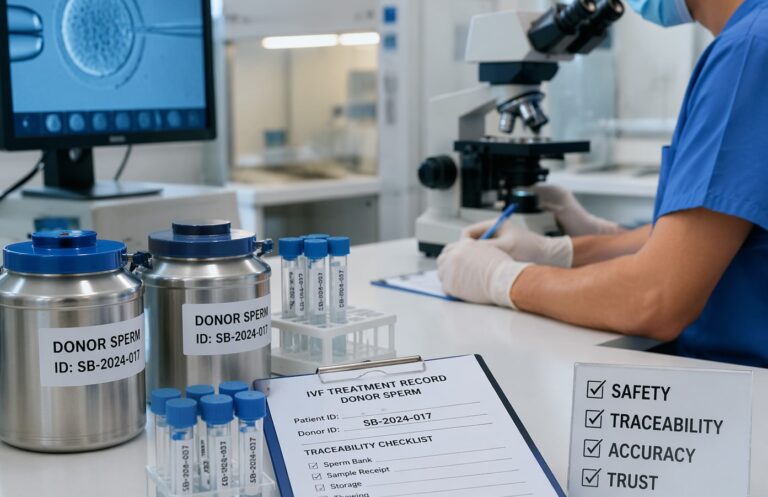
ICSI (Intracytoplasmic Sperm Injection) is not required in every IVF cycle. It is mainly recommended when there is male-factor infertility, low ovarian reserve, or previous fertilisation failure. The decision between conventional IVF and ICSI should always be based on medical evaluation not routine preference or financial pressure.
IVF and ICSI – Summary
- ICSI involves injecting a single sperm directly into an egg.
- It was developed to overcome severe male-factor infertility.
- ICSI is especially useful when:
- Sperm quality is poor
- Ovarian reserve is low
- There has been prior fertilisation failure
- Sperm quality is poor
- It does not automatically improve embryo genetic quality.
- The choice between IVF and ICSI is a medical decision, guided by embryology and andrology results.
What Is ICSI?
Intracytoplasmic Sperm Injection (ICSI) is one of the most widely used techniques in assisted reproduction. Developed in 1992, it revolutionised fertility treatment by allowing fertilisation even when sperm are unable to penetrate the egg naturally.
Unlike conventional IVF where sperm and egg are placed together in a laboratory dish and fertilisation happens “naturally” , ICSI involves:
- Selecting a single sperm under high magnification.
- Injecting it directly into the cytoplasm of a mature egg.
- Activating fertilisation and initiating cell division.
This technique was originally developed to help men with low sperm count or low motility become fathers using their own gametes, avoiding the need for donor sperm.
Today, it is widely performed in IVF laboratories by experienced embryologists.
IVF vs ICSI: What’s the Difference?
Both IVF and ICSI are laboratory fertilisation techniques. The difference lies in how the sperm enters the egg.
Conventional IVF
- Eggs are kept with surrounding granulosa cells.
- Sperm are prepared using a capacitation process (often via swim-up technique).
- Sperm and eggs are placed together in a dish.
- Fertilisation occurs naturally if sperm quality is adequate.
If sperm quality is poor, fertilisation may fail.
ICSI
- Surrounding cells are removed from the egg (decumulation).
- Only mature eggs (metaphase II) are selected.
- A sperm with optimal morphology and motility is chosen.
- A microinjector introduces the sperm directly into the egg.
ICSI bypasses the need for sperm to penetrate the egg independently.
When Is ICSI Recommended?
ICSI is primarily used in the following situations:
- Low percentage of motile sperm
- Abnormal sperm morphology
- Severe male-factor infertility
- Previous fertilisation failure
- Low ovarian reserve (to avoid losing eggs)
If sperm quality and ovarian reserve are both good, conventional IVF may be appropriate and allows a more natural selection process.
The choice must be based on:
- Embryology results
- Ovarian reserve evaluation
- Andrology analysis
- Previous treatment history
It is not a random or automatic choice.
Should ICSI Be Used in Every IVF Cycle?
No and it should not be treated as a routine addition.
ICSI is especially valuable when fertilisation might otherwise fail. However, in patients with:
- High ovarian reserve
- Good sperm parameters
- No history of fertilisation failure
Conventional IVF may be sufficient.
The key principle: The technique should match the medical need.
ICSI Success Rates
ICSI offers very high fertilisation rates around 80–90%.
It is particularly beneficial when:
- There are few eggs available
- Sperm quality is compromised
- There is concern about fertilisation failure
However, ICSI does not change the genetic quality of sperm or eggs. Embryo development still depends on:
- Egg quality
- Sperm DNA integrity
- Laboratory conditions
- Maternal age
Does ICSI Improve Embryo Quality?
ICSI increases the likelihood of fertilisation when natural penetration would be difficult.
However, it does not inherently improve genetic embryo quality.
Embryo quality is determined by:
- The genetic health of egg and sperm
- Maternal age
- Chromosomal integrity
- Laboratory environment
ICSI ensures fertilisation occurs and does not alter the genetic blueprint.
Why Does ICSI Sometimes Fail?
Despite high success rates, ICSI does not guarantee pregnancy. Failure may occur due to:
Egg Quality
Poor egg quality can reduce fertilisation or embryo development potential.
Sperm Quality
Even if sperm are injected, DNA fragmentation or genetic abnormalities can impact development.
Embryo Development Issues
Embryos may fail to reach the blastocyst stage due to chromosomal abnormalities.
Implantation Failure
Even a good embryo must implant successfully in the uterine lining.
Age
As maternal age increases, egg quality and quantity decline.
Laboratory Conditions
Temperature, air quality, and culture media influence embryo development.
Is ICSI Safe?
ICSI is currently considered a very safe procedure when performed in a well-equipped laboratory by experienced embryologists.
Historical concerns were linked to earlier technology. Modern microscopes and microinjection tools significantly reduce risks.
The main technical risk is potential mechanical damage to the egg during injection. However, most eggs survive the procedure successfully.
Does ICSI Increase the Risk of Autism or Chromosomal Abnormalities?
Research on ICSI and autism spectrum disorders has produced mixed results, with no conclusive evidence of a direct causal link.
Some studies suggest slightly higher rates in assisted reproduction overall, but this may relate to:
- Parental age
- Genetic predisposition
- Underlying infertility factors
Similarly, while concerns exist about bypassing natural sperm selection, most children born via ICSI are healthy.
Preimplantation genetic testing (PGT) can be used alongside IVF/ICSI to screen embryos before transfer.
Are ICSI Babies Healthy?
Most children conceived through IVF and ICSI are healthy and do not have more health problems than naturally conceived children.
Some studies indicate slightly increased risks of:
- Low birth weight
- Preterm birth
However, the majority of babies born after ICSI are healthy.
Does ICSI Select the Best Sperm?
During ICSI, embryologists select sperm based on:
- Motility
- Morphology
- Structural appearance
In cases of slow sperm, selection may involve identifying mature sperm based on receptor presence in the plasma membrane.
This allows selection of sperm most likely to fertilise successfully.
The Role of the Embryologist
ICSI requires both technical precision and biological judgement.
The main challenges include:
- Working with fragile oocytes
- Handling poor-quality sperm samples
- Avoiding damage during microinjection
- Selecting the most viable sperm
Training and experience are critical to maximise success and safety.
ICSI Costs and Inclusion in IVF Cycles
In some countries, ICSI is included within standard IVF packages and does not incur additional cost.
In other countries, patients may be charged extra for ICSI, which can influence decision-making.
Ideally, the decision between IVF and ICSI should be based on medical evaluation, not financial considerations.
How does ICSI differ from IVF?
ICSI injects a single sperm directly into the egg. IVF allows sperm to fertilise the egg naturally in a dish.
What is the fertilisation rate with ICSI?
Around 80–90%.
Does sperm quality still matter in ICSI?
Yes. Genetic sperm quality remains important for embryo development.
Can ICSI damage the egg?
There is a small mechanical risk, but most eggs survive the procedure.
Does ICSI guarantee pregnancy?
No. Fertilisation does not guarantee embryo development or implantation.
Conclusion: To ICSI or Not to ICSI?
ICSI transformed assisted reproduction by overcoming barriers that once prevented fertilisation. It offers powerful advantages in specific medical scenarios particularly male-factor infertility and fertilisation failure.
However, it should not automatically replace conventional IVF.
The most appropriate approach depends on:
- Individual fertility diagnosis
- Ovarian reserve
- Sperm quality
- Previous treatment outcomes
The decision should always be made in consultation with fertility specialists, based on medical evidence and patient circumstances.