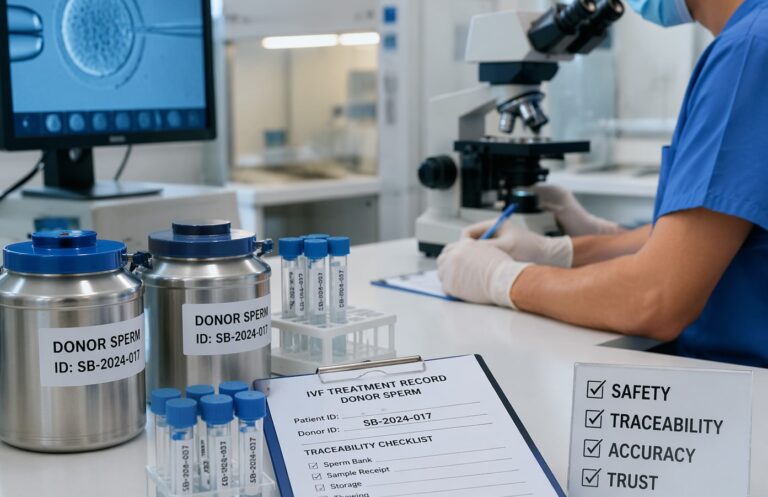
Semen quality can be influenced by lifestyle, environmental exposures, medications/drugs, occupational toxins, electromagnetic radiation concerns, and advanced paternal age. The starting point for evaluation is a semen analysis (seminogram), which measures semen volume, pH, concentration, motility, vitality, morphology, and leukocytes. When needed, additional tests such as sperm DNA fragmentation or sperm FISH can clarify hidden causes of infertility, implantation failure, or recurrent pregnancy loss.
Male Infertility – Summary
- It affects almost 15% of couples; male factor contributes up to 40–50%
- WHO reference values have declined; this doesn’t always mean sterility, but can make pregnancy harder
- Proven lifestyle/environment factors: obesity, smoking, drugs, chemicals
- Alcohol, toxins, heat/radiation, and paternal age can also impact semen parameters and DNA integrity
- The basic test is a seminogram, including both macroscopic + microscopic evaluation
- Extra tests may include: diagnostic capacitation, DNA fragmentation, FISH
- DNA fragmentation is a major cause of male infertility; MACS can help select sperm without signs of DNA damage/apoptosis for ICSI
- FISH can detect higher rates of chromosomal abnormalities in sperm, guiding embryo genetic testing and prenatal diagnosis considerations
- Not every test is for every patient, case selection matters
Who This Guide Is For
This is for couples or individuals asking:
- “What affects semen quality?”
- “What do semen analysis numbers actually mean?”
- “Should we test DNA fragmentation?”
- “What is a sperm FISH test and when is it used?”
- “If morphology is low, can IVF still work?”
- “Does smoking/alcohol/obesity really affect sperm DNA?”
This content is based only on a webinar by Elisa Moya Gutiérrez, Embryologist at UR Vistahermosa (Alicante).
You can see the full webinar here
Male Infertility: Why Semen Quality Matters
Infertility is defined as inability to achieve gestation after 1 year of unprotected sexual relations. It affects almost 15% of couples of reproductive age, with male factor responsible for up to 40–50% of cases of sterility in the couple.
Concerns about semen quality have increased due to declining seminal parameters set by the World Health Organization. This decline does not automatically mean sterility, but it can increase difficulty achieving pregnancy.
Causes of Male Sterility
Semen quality can be affected by factors that interfere with:
- Spermatogenesis (sperm formation)
- Transport through the male genital tract (testicles → ejaculation)
- Fertilization itself
Common causes associated with male sterility include:
- Varicocele (swelling of veins inside the scrotum)
- Infections in the seminal route
- Immunological pathologies
- Developmental anomalies
- Clinical pathologies
- Mechanical causes (erection/ejaculation disturbances)
- Genetic causes
- Toxic drugs
- Occupational factors
- Advanced paternal age
In this webinar, special focus was placed on environmental/lifestyle factors and what can be done to reduce harm or improve outcomes.
Lifestyle and Environmental Factors That Influence Semen Quality
Obesity and Male Fertility
Obesity is defined as BMI > 30 kg/m², associated with cardiovascular issues (high blood pressure, diabetes, hypercholesterolemia). Fertility can be affected through hormonal changes that reduce semen quality.
How obesity affects sperm production
- Testosterone decreases when fat mass is high
- Estradiol increases, inhibiting sperm production
- Semen volume may be affected
- Low testosterone may contribute to erectile dysfunction, reducing chances of natural conception
Obesity and ICSI outcomes
ICSI has helped couples with low semen quality or ejaculatory problems, but studies comparing normal vs high BMI suggest being overweight may adversely affect ICSI outcomes.
Smoking and Semen Quality
Smoking has been widely linked to:
- Decreased sperm count
- Damage to sperm DNA
Tobacco components (nicotine and other toxins) cross the hematotesticular barrier and appear in seminal plasma, directly influencing sperm quality. Studies also suggest smoking increases DNA fragmentation in sperm heads—potentially affecting natural fertilization and assisted reproduction outcomes.
Drugs That Affect Fertility
Many drugs can affect fertility, but the most harmful for reproduction include cancer treatments:
- Chemotherapy and radiotherapy can be aggressive to spermatogenesis
- Effects may be permanent or transient depending on drug type and radiation dose
Preventive sperm freezing
Sperm freezing is recommended at diagnosis of systemic/oncological disease, because the disease itself or treatment may endanger future fertility.
Other drug categories that may affect fertility:
- Immunosuppressants
- Neuro drugs (antidepressants, antiepileptics)
- Hormones like anabolic steroids
Anabolic steroids (synthetic derivatives of testosterone) may cause reproductive harm that is often (or most of the time) irreversible.
Alcohol and Fertility
Alcohol is widely consumed, and studies link alcohol with reduced fertility in men and women.
Alcohol may:
- Alter testosterone secretion
- Affect spermatogenesis
The European Association of Urology confirmed that heavy alcohol consumption can lead to:
- Significant sperm morphology changes
- Decreased seminal fluid volume
- Lower sperm concentration and motility
- Increased sperm DNA fragmentation
Toxic Occupational Exposures
Some occupations involve higher fertility risks due to exposure to toxic substances or physical agents, including:
- Pesticides (farmers)
- Radiation or heat (foundry workers)
- Glycol ethers (foundry workers)
Heat/radiation and certain metals are documented as toxic to sperm, especially with high exposure.
Electromagnetic Radiation (Mobile Phones, Laptops, Wi-Fi)
Concerns exist because these technologies emit electromagnetic radiation, which could alter reproductive endocrine mechanisms and testicular function.
Animal investigations show exposure to mobile phone radiation can decrease:
- Sperm viability
- Motility
- Total antioxidant capacity
The biological effects in humans are not fully determined, and more studies are needed.
Advanced Paternal Age
While advanced maternal age is widely discussed, there is increasing evidence that paternal age matters too.
A commonly used criterion for “advanced paternal age” is over 45 years at conception.
Possible effects described include:
- Increased oxidative stress → cell and DNA damage
- Decreased testosterone → reduced sperm mobility and volume
- Lower embryo quality in assisted reproduction
- Increased risk of psychiatric diseases in offspring (ADHD or autism)
- Increased miscarriage risk
Semen Analysis (Seminogram): What It Measures
The seminogram is the essential baseline test before assisted reproduction. It’s the most basic test and also one of the most important.
It includes:
1) Macroscopic Study (No Microscope)
Measures:
- Volume: normal if > 1.4 ml
- pH: normal between 7 and 9 (outside range can be linked to infection)
- Viscosity and liquefaction: semen should liquefy naturally (~20 minutes) and be fully liquid before analysis
2) Microscopic Study (Microscope Required)
Measures:
- Sperm concentration: normal if > 16 million/ml
- Motility: progressive movement should be > 32%
- Vitality: > 58% alive for normal sample
- Morphology: at least 4% normal forms
- Leukocytes: ≤ 1 million/ml (higher suggests infection)
Reference Table
| Parameter | “Normal” threshold described |
| Volume | > 1.4 ml |
| pH | 7–9 |
| Concentration | > 16 million/ml |
| Progressive motility | > 32% |
| Vitality | > 58% alive |
| Morphology | ≥ 4% normal forms |
| Leukocytes | ≤ 1 million/ml |
When a Basic Seminogram Isn’t Enough
Additional tests mentioned include:
Diagnostic capacitation
- Measures progressive motile sperm count
Sperm DNA Fragmentation Test
- Measures damage/breaks in sperm genetic material
Sperm FISH Test
- Detects genetic abnormalities (chromosomal issues) in sperm
The key principle: many tests exist, but selecting the right ones depends on the couple’s specific case.
Sperm DNA Fragmentation: What It Is and Why It Matters
Sperm DNA fragmentation refers to lesions or breaks in sperm genetic material and is described as a major cause of male infertility.
Causes may include
- Intrinsic factors (imperfect sperm maturation, genetic alteration)
- External factors (lifestyle/environment)
Studying fragmentation can improve IVF planning. It can’t always be prevented, but laboratory techniques can help improve selection.
Recommended situations for fragmentation testing
- Unexplained infertility
- Repeated implantation failure
- Poor-quality embryos
- Men who had/have radical treatments
- Men aged 45+
- Chronic diseases like diabetes
- Men who smoke
MACS Technique (How Clinics May Improve Selection)
The most used and clinically tested technique described to improve this condition is MACS.
What MACS does
- Immunomagnetic selection of sperm without signs of DNA damage or apoptosis (cell death)
How it works (step-by-step)
- Sperm is incubated with annexin coated with magnetic microparticles
- Annexin binds damaged/apoptotic sperm
- Mixture passes through a column with a magnetic field
- Damaged sperm remain; healthy sperm pass through
- Healthy sperm is then used for ICSI or fertilization
Sperm FISH Test: What It Is and When It’s Used
Humans have 23 chromosome pairs (diploid). Gametes (sperm/oocytes) carry one set (haploid) through gametogenesis. This process isn’t perfectly efficient, and some sperm may have abnormal chromosome numbers (aneuploidy).
Indications for FISH testing
- Recurrent pregnancy loss
- Recurrent implantation failure
- Male partners with poor semen quality
- Male partners with abnormal karyotypes
If FISH shows increased chromosomal alterations
The approach described is to consider:
- Preimplantation genetic diagnosis to help ensure embryos transferred are genetically normal
- Prenatal diagnosis during pregnancy
Morphology dropped from 10% to 2% to 1%—is that progressive degeneration?
Morphology is usually not so variable over time, so this pattern is described as rare and worth analyzing. If other parameters (volume, concentration, motility, vitality, pH) are good, it’s unusual. Getting additional opinions and repeating semen analysis in another clinic/lab can help confirm whether results are consistent.
Should we repeat semen analysis in another clinic?
Yes. Repeating in a different lab can help verify whether the findings are consistent.
If morphology is only 1%, what’s the best IVF approach?
ICSI would likely be used. With ICSI, the best sperm is selected for fertilization.
Is DNA fragmentation included in routine semen analysis every time?
No. It’s performed separately depending on the infertility case. Some couples need only a seminogram; others may be advised to add DNA fragmentation testing.
If there’s repeated implantation failure, should we check chromosomal issues before DNA fragmentation?
Yes—chromosomal issues should be checked first in that scenario.
What is the cut-off point for sperm DNA damage (DFI)?
A cut-off point mentioned for sperm DNA damage is 30%. DFI is not typically used for IUI in this context.
Does ICSI “handle” DNA fragmentation if it’s present?
No. ICSI selects sperm mainly by morphology and motility; it does not directly fix fragmentation. To reduce fragmentation risk, MACS can be used before ICSI.
Does your clinic do ICSI in every cycle?
No. ICSI is recommended when sperm shows an alteration. If sperm is in perfect condition and there’s no male factor, conventional IVF may be used.
Is conventional IVF cheaper than ICSI?
The decision is framed as what’s best medically, not about price. Some patients prefer conventional IVF, but sperm and ovarian assessment should guide the decision.
Does frozen sperm retain quality after thawing?
Motility may decrease by about 10–15%, which is considered normal. DNA fragmentation is not affected much. Overall, the decrease is not described as significant.
Can MACS be used on frozen sperm with high DNA fragmentation?
Yes, MACS can still be used on a frozen sample.
We were told fragmentation testing isn’t needed because concentration/motility are extremely low—do you agree?
It’s suggested that it doesn’t hurt to do fragmentation testing, especially if there has already been a failed ICSI/IVF cycle. More information can help understand what happened and plan better.
Does drinking two bottles of red wine a week affect sperm?
Not considered a high amount in this context; concerns focus more on daily heavy consumption. Small amounts are not expected to cause damage, though alcohol/tobacco/drugs are never ideal.
Do hypertension drugs affect sperm?
Uncertain here; better to consult a doctor. Chemotherapy, some neurological drugs, and hormones are known to be aggressive for spermatogenesis.
With 1% normal morphology, won’t ICSI take too long to find good sperm?
Sperm processing includes capacitation to isolate progressive sperm, removing many non-moving sperm and making selection easier. It is presented as manageable in the lab.
Key Takeaways
| If your situation is… | Focus on… | Why |
| Unexplained infertility | Seminogram + consider fragmentation | Fragmentation is a major male-factor cause |
| Recurrent implantation failure | Chromosomal issues first, then fragmentation | Prioritize likely limiting factors |
| Very low morphology | ICSI | Allows selection of best sperm |
| Smoking / age 45+ / diabetes | Fragmentation testing | Listed as recommended indications |
| Suspected sperm chromosomal issues | FISH test | Detects sperm aneuploidy risk |
| High fragmentation | Consider MACS before ICSI | Selects sperm without damage/apoptosis |