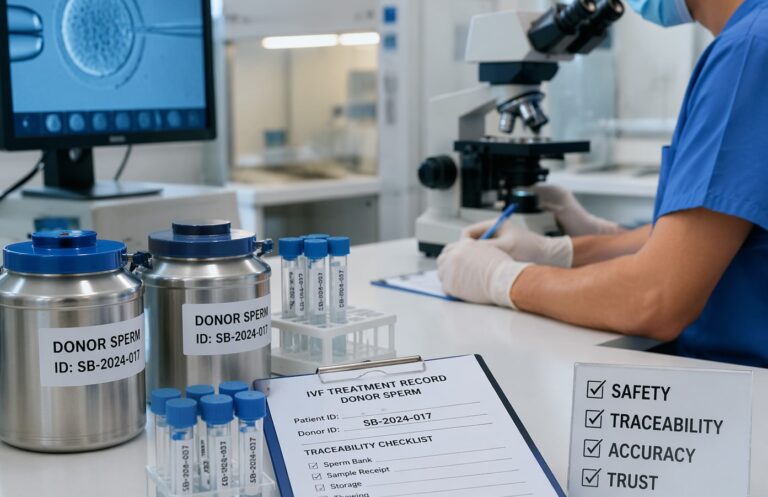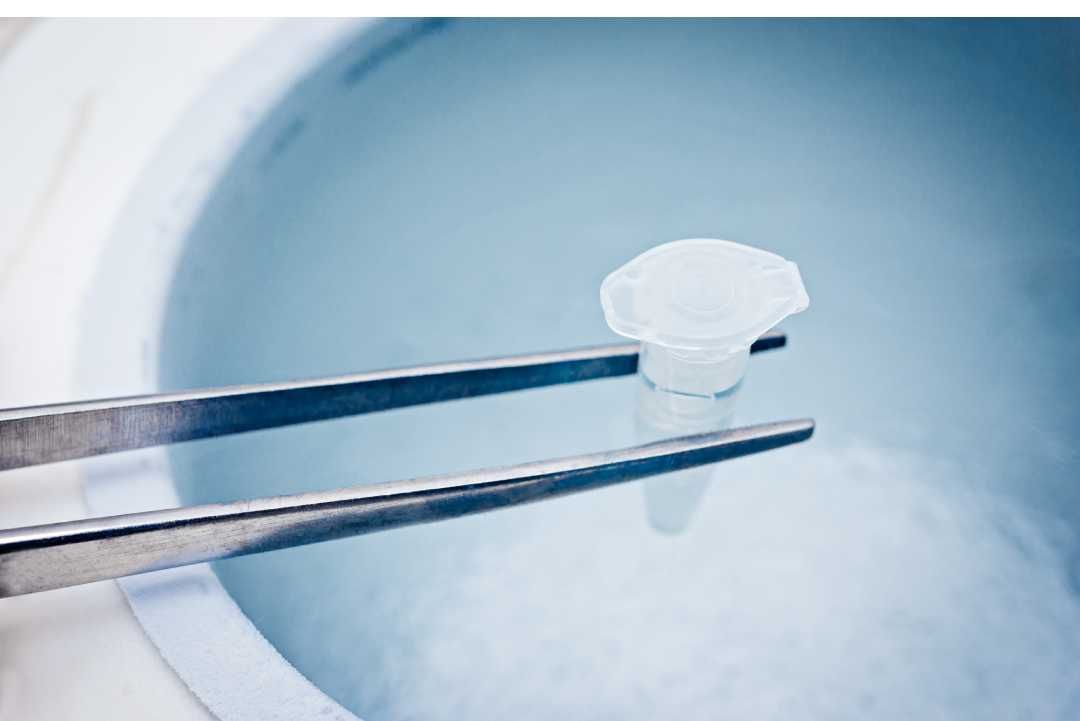
Egg freezing is described as a permissible fertility preservation method. However, it is not intended to act as a form of reproductive insurance. The decision to proceed should be based on informed understanding rather than an assumption that it guarantees future success.
Women may consider egg freezing for:
- Medical reasons, for example patients with cancer
- Social circumstances, for example not being in a relationship
- Awareness of potential decline in ovarian reserve due to personal or family factors
The decision should not be driven solely by relationship status but rather by an informed consideration of future ovarian function.
This article is based on the webinar “Egg freezing. Case studies and patient’s stories“
Summary
- Egg freezing is considered permissible and is used to preserve fertility, but it is not intended to function as a guarantee or “insurance” for future pregnancy.
- The most favorable time to freeze eggs is when a woman is younger and without underlying medical conditions, rather than in the late 30s.
- Ovarian reserve testing (AMH and ultrasound for antral follicles) is required before proceeding, but these tests do not determine egg quality or survival after thawing.
- Survival rates for frozen eggs are typically around 75–80% after thawing, and fertilization rates are comparable to fresh eggs.
- Success rates depend on the age at the time of egg freezing, not the age at which the eggs are used.
Optimal Timing for Egg Freezing
The timing of egg freezing is a key factor:
- It is most appropriate when women are young, healthy, and without underlying medical problems
- It is not recommended to delay until the late 30s if avoidable
Although egg freezing remains possible at older ages, expectations should be adjusted accordingly due to age-related changes in outcomes.
Storage Duration (UK Context)
- Eggs can typically be stored for up to 10 years in the UK
This creates a practical consideration:
- Freezing at age 30 allows potential use up to around age 40
- Freezing at age 20 may require use by around age 30
These constraints may influence decision-making depending on individual circumstances.
Pre-Treatment Assessment: Ovarian Reserve
Before starting an egg freezing cycle, ovarian reserve testing is required.
Required Tests
- AMH (Anti-Müllerian Hormone)
- Ultrasound scan for antral follicle count (AFC)
What These Tests Do—and Do Not Show
- They help determine whether egg freezing is feasible and estimate response
- They do not determine:
- Egg quality
- Likelihood of survival after thawing
This limitation must be acknowledged when making decisions.
Egg Freezing Process
Timeline
- If the decision is made mid-cycle, there may be a wait of approximately two weeks before starting stimulation
- From the start of stimulation to egg collection, the duration is typically about 12 to 15 days
Process Steps
- Hormonal stimulation injections
- Monitoring of follicle development
- Egg retrieval procedure
Medications
The hormones used are the same as those produced naturally, but they are administered to support the development of multiple follicles rather than a single ovulation.
Risks and Side Effects
Procedural Risks
- Bleeding
- Infection
Stimulation-Related Risk
Ovarian Hyperstimulation Syndrome (OHSS):
- Occurs when the ovaries produce a large number of follicles
- May involve fluid accumulation, swelling of the legs, or fluid in the lungs in some cases
- The risk is considered very low with modern protocols and affects approximately 2 to 3 percent of patients
Other Effects
No specific side effects such as changes in mood or general well-being are expected, as the hormones used are the same as those produced naturally.
Egg Survival, Fertilization, and Success Rates
Survival and Fertilization
- Around 80 percent of eggs can be successfully frozen
- Approximately 75 to 80 percent survive the thawing process
- Fertilization rates of thawed eggs are comparable to those of fresh eggs
Embryo vs Egg Survival
- Embryos are more robust, with approximately 98 percent survival for blastocysts
- Eggs have a survival rate of about 80 percent
Pregnancy Rates
Clinical pregnancy rate per embryo transfer:
- Frozen eggs: around 55 percent
- Fresh eggs: around 55 percent
Age Dependency
- Outcomes decline with increasing age
- In older women, for example at age 41, the chance of success may be around 10 percent or lower
Key Clinical Principle: Age at Freezing vs Age at Use
Success is determined by the age at which the eggs were collected and frozen.
It is not determined by the age at which the eggs are later used.
Examples:
- Eggs frozen at age 32 and used at age 39 have outcomes based on age 32
- Eggs frozen at age 37 have outcomes based on age 37, even if used later
Egg Yield from Follicles
- Not all follicles yield mature eggs
- Approximately 80 to 90 percent of mature follicles contain an egg
Age influences:
- The number of eggs retrieved
- Egg quality
- The likelihood of successful fertilization
Fresh vs Frozen Outcomes
Evidence suggests that live birth rates from frozen eggs are comparable to those from fresh eggs, provided that the eggs survive thawing and are successfully fertilized.
Embryo Transfer Considerations After Freezing
Timing Before Frozen Embryo Transfer
- A natural menstrual cycle is required before starting a frozen embryo transfer
- If a natural cycle does not occur, a period may be induced before proceeding
Natural vs Hormone-Controlled Cycles
- No overall difference in success rates has been observed
- However, one approach may work better for some women than another
- The timing of endometrial receptivity remains a key factor
Endometrial Receptivity and Repeated Failure
When repeated embryo transfer failures occur, two areas should be evaluated:
- Embryo-related factors
- Genetic testing of embryos may be considered
- Endometrial factors
- Assessment of receptivity may be required
Receptivity Testing
- Endometrial Receptivity Analysis (ERA)
- This evaluates:
- Gene expression
- The timing of the implantation window
- Microbiome characteristics, including lactobacillus presence
Important Distinction
Endometrial thickness and trilaminar appearance alone do not determine whether the endometrium is receptive.
Genetic Testing of Embryos (PGT)
- Often used particularly in women older than 37 due to increased likelihood of aneuploid embryos
Estimated Risk of Abnormal Embryos
- Under 35 years: approximately 30 percent
- Over 39 years: approximately 80 percent
Impact
- Helps identify embryos that are genetically normal
- Increases the chance of successful pregnancy
- Reduces the risk of miscarriage
Limitations
- The risk of embryo damage from biopsy is below 5 percent
Storage and Costs
- Eggs and embryos can be frozen for short durations such as days or weeks, or for longer durations up to 10 years
- Storage cost example: approximately £300 per year
What percentage of frozen eggs survive thawing?
Approximately 75 to 80 percent survive thawing, and fertilization rates are comparable to fresh eggs.
Is age a factor in egg freezing outcomes?
Yes. Age affects the number of eggs retrieved, the quality of the eggs, and the likelihood of successful fertilization. It is the main contributing factor.
Are success rates different in natural vs induced frozen embryo transfer cycles?
No overall difference has been observed. However, outcomes may vary depending on individual endometrial timing and receptivity.
Should testing be done after repeated IVF failures?
Both embryo genetic testing and endometrial receptivity testing may be considered. The decision depends on prior outcomes and the suspected cause of failure.
What is the name of the endometrial receptivity test?
Endometrial Receptivity Analysis (ERA), sometimes combined with microbiome assessment.
Is there a minimum time embryos must be frozen?
No. Embryos can be frozen for short or long durations without concern.
What are the main risks of egg freezing?
The main risks include ovarian hyperstimulation syndrome, which affects approximately 2 to 3 percent of patients, and procedural risks such as bleeding and infection. No additional systemic side effects from hormones are expected.
Conclusion
Egg freezing is an established fertility preservation method with outcomes that can be comparable to fresh IVF under appropriate conditions. However:
- Success is not guaranteed
- Outcomes are strongly dependent on age at the time of freezing
- Testing provides guidance but does not provide certainty
- Decision-making remains individualized and dependent on patient-specific factors
All steps, from assessment through to embryo transfer, require interpretation within the clinical context rather than reliance on generalized expectations.